
Automated, high-throughput in situ hybridization of sea urchin (Lytechinus pictus) embryos
Yoon Lee, Chloe Jenniches, Rachel Metry, Gloria Renaudin, Svenja Kling, Evan Tjeerdema, Elliot W. Jackson and Amro Hamdoun
Development
September 22, 2025
Abstract
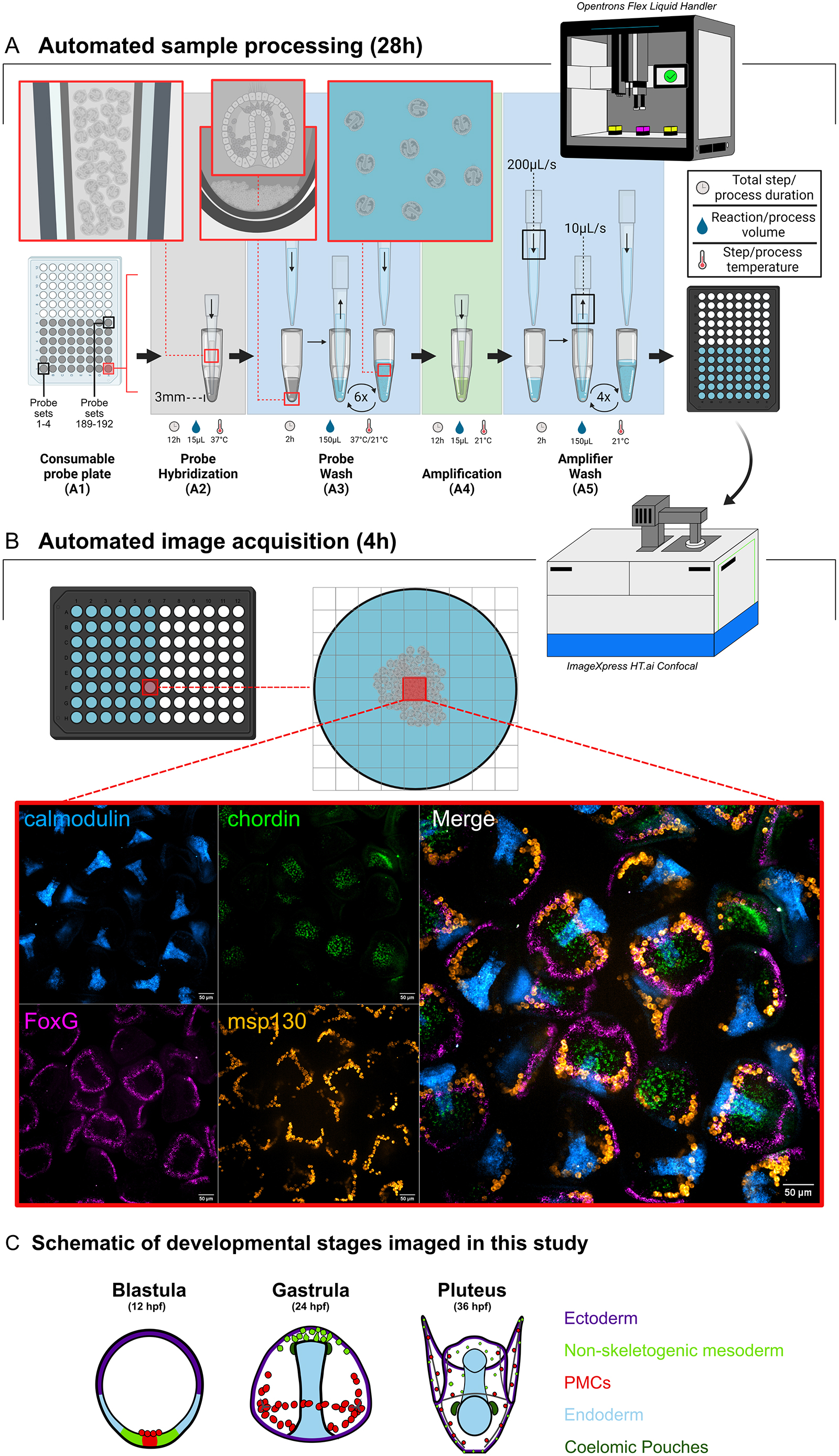
Despite the reach of in situ hybridization (ISH) in developmental biology, it is rarely used at scale. The major bottleneck is the throughput of the assay, which relies upon labor-intensive manual steps. The goal of this study was to develop a high-throughput, automated hybridization chain reaction (HCR) pipeline for the sea urchin (Lytechinus pictus). Our method, which we term high-throughput (HT)-HCR, can process 192 gene probe sets on whole-mount embryos within 32 h. The physical properties of sea urchin embryos enabled us to utilize a 96-well plate format, miniaturized reaction volumes, a general-purpose robotic liquid handler and automated confocal microscopy. Using this approach, we produced high quality localization data for 101 target genes across three developmental stages. The results reveal the localization of previously undescribed physiological genes, as well as canonical developmental transcription factors. HT-HCR represents an order of magnitude increase in the throughput of spatial expression profiling studies utilizing the sea urchin. This will enable more-sophisticated perturbation analyses and drug-screening efforts in this emerging animal model.